

Housing options
In France, most housing is available via property owners, real estate agencies, notaries, the government, or non-profit organisations. Rentals may be private, public, or government subsidised. Sometimes they are open to everyone, and sometimes they are exclusively for students. Having a detailed understanding of your options will help you make a well-informed decision and budget for advance fees. It will also arm you against misleading ads and exorbitant rents.
We do not provide information about buying property.
Private housing
Private housing consists of places rented out by property owners. There are two categories:
- Unfurnished rentals have neither furniture nor appliances. In general, lessors are looking for renters whose monthly income is equivalent to at least 3 months’ rent.
- Furnished rentals come with basic kitchen appliances, most commonly a sink, electric burners, a refrigerator, a microwave, and dishes.
In addition to thinking about whether you want furnished or unfurnished housing, you should consider whether you want to live on your own (e.g., in a studio, apartment, or house), share a place with roommates, or find a room in someone’s home.
Below are some rental websites to get you started:
- Ads from private lessors: Le bon coin, Se loger, PAP, Airbnb, Entre particuliers, Logis demande, Acheter Louer
- Ads from rental agencies: À vendre À louer, Century 21, Foncia, Guy Hoquet, L’Adresse, La Forêt, Nexity
- Ads from notaries: immobilier.notaires, immonot
- Ads for shared housing: Colocation, Flatlooker
- Ads for student housing: Lokaviz
- Some terminology to help you decipher rental ads

Social housing
In France, social housing is for people with low earnings. It is also commonly referred to as HLM housing (for habitation à loyer modéré). It is therefore means tested and requires applicants to meet certain conditions established by the government. Demand for social housing is high, so you may have to apply several years in a row.
Useful links
Short-term rentals
You should consider temporary housing if you are coming to France for a shorter stay. Short-term rentals are not just for tourists or holidaymakers. They are also commonly used by people travelling to France for brief work trips.
Useful links
Student housing
Subsidised by the French government, the Regional Organisation for Educational Services (Centre régional des œuvres universitaires et scolaires, or CROUS) provides student housing. Located near university campuses and institutions of higher education, CROUS residences are for students from low-income families and/or students who are studying far from home. Often, these residences are made up of individual rooms rented out at a low cost.
To determine your eligibility, you must submit an application (dossier social étudiant, or DES):
- Apply for a long stay during the period from September to August
- Apply for a short stay of up to 30 nights
Useful links

Private student residences
Private student residences are a good alternative if you do not get a spot in a CROUS residence. Although often more expensive, some private residences are nonetheless competitively priced given the general student housing market. They also offer various amenities, such as furnished rooms with private bathrooms, equipped kitchenettes, internet access, laundry facilities, exercise facilities, and a sense of community.
Useful links
Hostels
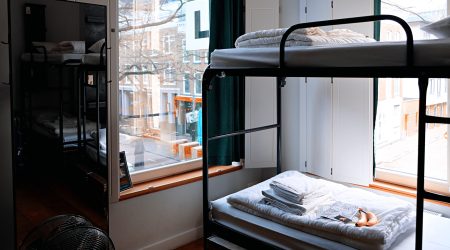
Hostels offer individual or shared housing to students or young professionals. They may be run by public, private, or non-profit organisations. Hostels are often located in the city centre and may rent rooms with full or half board. They frequently have common spaces to foster community, but they also have some rules, a bit like boarding schools. For example, meals occur at fixed times, and there are restrictions on the hours at which you can come and go.
For more information about hostels, explore the following websites (in French):
– The National Union for Youth (Union Nationale pour L’Habitat des Jeunes, or UNHAJ) is a network of more than 330 non-profit organisations found in over 250 cities. The UNHAJ offers housing and services, including employment info, health info, dining options, organised trips, and leisure activities, for young people who are working, studying, or doing internships. To benefit, you must be between 16 and 30 years of age. To apply for housing, get in touch directly with the UNHAJ residence centre of interest because housing types and application procedures may differ.
– The National Union for Student Housing (L’Union Nationale des Maisons d’Étudiants, or UNME) is a network of several housing providers found across the country that host French and foreign students. To reserve a room, contact the hostel of interest directly.
– The Local Committees for Independent Living by Young People (Les Comités Locaux pour le Logement Autonome des Jeunes, or CLLAJ) mainly work with individuals between the ages of 18 and 25. The CLLAJ hosts, educates, and guides young people in their search for housing. This work includes helping with the application process and teaching people how to maintain their living spaces. To find housing, get in touch with the CLLAJ of the town or city where you first lived in France.
– ADOMA has a variety of options, including temporary, furnished, independent, and semi-independent housing. You must apply online, and applications are generally subject to a means test. After submitting your application, you will be assigned a registration number. The monthly cost of housing includes rent and utilities (e.g., water, electricity, insurance). If you live in ADOMA housing, you can apply for various forms of financial assistance, such as the housing allowance.
Living in someone’s home
With friends or family
You can temporarily or permanently live in someone’s home without paying rent; the French government legally recognises such housing situations. Do not hesitate to reach out if you know someone in France who can host you.
With a senior citizen
Students can also choose to live with senior citizens who have a spare room at home. There are several potential scenarios: free housing in exchange for your regular presence and assistance around the house; mutual aid and a share of the utilities; or low rent in exchange for the occasional social interaction and sometimes lending a hand around the house.
Useful links
- Association Ensemble2générations
- Network of associations of the Intergenerational Solidarity Cohabitation
- Association Le Pari Solidaire
With a family
Students may be housed by families for free in exchange for services such as tutoring, babysitting, and/or language immersion.
Useful links
- Cohomly, ToitChezMoi, Lyon Bleu (Lyon)

Useful links